TECH & AI · FOR BUSINESS OWNERS IN SINGAPORE

Less busywork.
More room
to grow.

Workflow automation architecture.
Practical AI. A clearer way to work.

I help you design the operating logic behind your business: how customers arrive, work gets assigned and follow-ups happen. Reduce founder dependency, make time and costs visible, and build systems your team can carry forward.

For founders, business owners, C-suite leaders and their teams.
No technical background needed to begin.

Venie working on her laptop beside her baby in a stroller
VENIE LIMFounder & Director, ProgressLab™

A founder’s experience. A mum’s understanding.

FOR THE LEADER EVERYTHING COMES BACK TO

You’ve invested in help.
Why does everything
still need you?

You have people, software and plenty of meeting notes. Yet the chasing, explaining and remembering still land on you.

When every handover waits for you, work stalls. Follow-ups can slip, decisions wait, and another evening becomes catch-up time. That is a business cost, even when it never appears on an invoice.

My workflow architecture work starts here: finding what keeps pulling you back in, then designing how the work can move forward.

I’m busy all day. The important work still waits.

The inbox, approvals and follow-ups fill the hours you wanted for clients, strategy or life outside work.

WHAT WE CAN DESIGN TOGETHER

Map where your time goes, choose a recurring task to redesign, and define what can be prepared, delegated or automated before it reaches you.

A priority workflow map, with a baseline for time and effort.
My PA takes too long. AI seems faster.

You delegate, then spend time explaining, correcting and chasing. The handover has become another job.

WHAT WE CAN DESIGN TOGETHER

Design a PA + AI workflow: AI prepares drafts and summaries; your PA checks, coordinates and follows through; you set the decisions that need your approval.

Clear briefs, reusable templates and agreed responsibilities.

I use AI, but it hasn’t changed my workload.

You get an answer, then still have to re-explain the context, check the details and move everything into the right place.

WHAT WE CAN DESIGN TOGETHER

Give AI approved business context, a repeatable task and a review checklist. Work through the whole process from your brief to a usable output.

A practical AI workflow you can repeat and improve.

I don’t know how to automate my backend.

Enquiries, bookings, invoices and team updates live in different places. You are the person connecting the dots.

WHAT WE CAN DESIGN TOGETHER

Map the trigger, shared record, next action, owner and exception path. Assess where your existing tools can connect and what is worth building first.

An automation blueprint with priorities and implementation scope.

AND IF POCKET STILL FEELS LIKE A NOTEPAD…

Your meeting is captured.
Who moves it forward?

A recording is useful. The value grows when the decisions reach the right people and the next actions have somewhere to go.

We can work with your Pocket notes or transcript to design a repeatable process for the work after the meeting.

A WORKFLOW WE COULD DESIGN

  1. A clear decision brief

    Check the source, separate decisions from ideas and surface what still needs an answer.

  2. Actions with owners

    Confirm responsibilities and due dates, then place agreed tasks in your team’s working system.

  3. Follow-ups ready for review

    Prepare an email, proposal outline or internal brief for you or your PA to approve.

  4. Context for the next meeting

    Keep approved decisions and open actions together, so the next conversation builds on the last.

We start with notes or an export from your Pocket setup. Connections to task or CRM tools are assessed for your setup and scoped separately.

What keeps landing back on your desk?

Bring one recurring frustration. Let’s map the people, information and steps around it, and identify a useful place to begin.

Discuss my workflow

THE BUSINESS CASE FOR BETTER SYSTEMS

Your time. Your costs.
Your capacity to grow.

Connect the work behind the scenes
to the outcomes you care about.

Get time back

Find the copying, chasing and repeated explanations that fill your week. Design a clearer path from the first enquiry to the next action.

Look at: time per task, including review.

Make costs visible

Assess where rework, duplicate tools and manual admin add up. Compare the effort to improve a workflow with the value it could create.

Count: setup, subscriptions and upkeep.

Build for a growing team

Give your processes a shared home, a clear owner and reliable handovers, so more work can move forward without every question coming back to you.

Track: missed handovers and repeat errors.

WHERE MONEY COMES IN FOR OPERATORS

Revenue needs a system
behind it.

Winning an enquiry is one step. Converting it, delivering well and giving customers a reason to return each need a working process. These are five places we can look for commercial value.

Customer acquisition engine

Connect lead sources, qualification, enquiry response and booking into a journey with a clear next action.

WHAT TO MEASUREEnquiry-to-booking conversion and acquisition cost.

CRM automation

Keep customer history, pipeline stages, task owners and follow-up reminders together.

WHAT TO MEASUREResponse time, overdue follow-ups and repeat business.

Dispatch optimisation

Match jobs to skills, availability, location and service windows, with a path for reassignments.

WHAT TO MEASURETravel time, team utilisation and completed jobs.

Recurring revenue contracts

Build the workflow around service plans: scheduled delivery, renewal dates, billing and accountable owners.

WHAT TO MEASURERenewals, contract retention and delivery margin.

Referral flywheels

Connect a completed service to feedback, a timely referral request and a traceable new enquiry.

WHAT TO MEASUREReferred enquiries and the customers they become.

That is where operational architecture matters.

TWO DIFFERENT BRIEFS. TWO DIFFERENT AMBITIONS.

What are you
really building?

The difference between a website and a business operating system is easy to underestimate. One introduces your offer. The other defines how your business delivers it.

Here, an operating system means your people, processes, records and tools working together. The architecture is the blueprint that connects them.

THE CUSTOMER-FACING BRIEF

“Build me a website.”

Help people discover the business, understand the offer and make an enquiry.

The front door to your business.

THE OPERATING BRIEF

“Build me an
operating system.”

Connect acquisition, customer records, dispatch, delivery and follow-up, with clear ownership at every step.

The structure that carries the work.

THE FOUNDATION OF THE SOLUTION

The workflow
architecture.

These five layers turn a business idea into an operational design. They define what needs to work before we choose what to build or automate.

Operational logic
The rules for decisions, approvals, priorities and exceptions. What should happen, and why?
Dispatch flow
How work reaches the right person, and how absences, delays or scheduling conflicts are reassigned.
CRM structure
How customers, enquiries, jobs, contracts and their history connect in a reliable shared record.
Automation backbone
The triggers, connections and actions that move routine work forward, with checks when something fails.
Scalability framework
The roles, permissions, reporting and repeatable standards that support more work, teams or locations.

Measure the value before adding more tools. Compare time per completed task, review effort and missed follow-ups against setup and ongoing costs. Time released is useful capacity; cash savings depend on actual spending.

Let’s look at your workflow

THINKING AT A SYSTEMS LEVEL

Can the business move
without you moving it?

Running a business, building a system and shaping an operating platform ask different things of a founder. The shift begins when the way work gets done can live beyond one person’s memory.

THE OBJECTIVEReduce founder dependency.

  1. 01 · THE BUSINESS

    The founder is
    the operating system.

    • Customer complaintFounder
    • Technician sickFounder
    • Scheduling conflictFounder
    • Follow-upFounder

    When the founder steps away, routine work stalls. The business struggles.

  2. 02 · THE BUSINESS SYSTEM

    Work has a process
    and a responsible owner.

    • CRM
    • SOPs
    • Automation
    • Reporting
    • Standard workflows

    The founder no longer manually touches every routine process. Exceptions reach the right decision-maker.

  3. 03 · THE OPERATING PLATFORM

    The way you work
    can be carried forward.

    Shared records, decision rules and delivery standards can support more people, teams or locations.

    Managers see performance, new teams learn the model, and operating knowledge stays with the business.

    The founder can focus on direction, quality and growth as the business becomes more scalable.

LEVEL UP WITH A BUSINESS SYSTEM

A clear path from customer to follow-up.

An illustrative service workflow, shaped around your team, tools and approval rules.

  1. Customer

    The request enters through an agreed channel.

  2. CRM

    The customer, need and next action share one record.

  3. Assigned

    An owner and service window are confirmed.

  4. Completed

    The work and outcome are recorded and checked.

  5. Follow-up

    A next action, renewal or feedback request is tracked.

Routine steps follow agreed rules. AI can help prepare drafts or summaries. People handle judgement, approvals and exceptions, with a clear record of what happened.

BUILDING REAL ASSETS FOR OPERATORS

Operating intelligence
that transfers.

The lasting value is the documented know-how: how decisions are made, work is delivered and improvements are tracked. Give your team, managers and implementation partners something they can understand and use.

Discuss my operating architecture
Decision logic
Process maps, rules and escalation paths that explain how the business works.
Structured records
CRM relationships, data definitions and customer history that preserve useful context.
Delivery standards
SOPs, automation specifications and review checklists a team can follow.
Management visibility
Reporting definitions, ownership and handover guidance to keep improving the operation.

FROM MY PROGRESSLAB JOURNEY

Experience today.
A bigger vision ahead.

I’m Ven, Founder & Director of ProgressLab™. My AI journey began with the work of building a business: thinking, researching, communicating and designing how things should run.

Through Well with Ven, I bring those lessons into practical conversations about your business, your bottlenecks and a manageable next step.

Explore ProgressLab
USED IN MY FOUNDER JOURNEY

AI supports my work. People remain responsible for decisions and day-to-day operations.

Thinking & decision support

I use conversational and research-assisted AI to organise ideas, compare options and turn discussions into operating plans. I check sources and make the decisions.

What this could mean for you

A clearer weekly plan, a better decision brief, or a way to compare business scenarios.

Content, documents & visuals

I work with text, PDFs, screenshots and spreadsheets to draft communications and review information. Generated visuals help me explore concepts before production.

What this could mean for you

Reusable customer replies, proposals, document reviews and creative briefs, with a human checking the result.

Systems & workflow design

AI has helped me design table structures, forms and automation logic for enquiries, onboarding, payment tracking and workforce records, using conventional business tools.

What this could mean for you

A practical map of the records, rules, responsibilities and connections your operation needs.

Knowledge that builds over time

I organise notes, decisions and approved references into a growing knowledge asset. AI helps connect context across operations, staffing, programmes and partnerships.

What this could mean for you

A reusable source of truth, so you and your team spend less effort finding and explaining the same information.

The foundation at PGL today: TAIP centres on structured educational observations, support records and human review. AI can assist with organising or drafting; educators remain responsible for interpreting observations and deciding on support.

THE DIRECTION OF TRAVEL

From useful workflows
to connected intelligence.

ProgressLab’s longer-term vision connects its operations, TAIP’s educational observation and review framework, and a future intelligence layer. These are roadmap possibilities, not live PGL capabilities or ready-made WWV products.

  1. 01Structure the human process
  2. 02Connect reliable records
  3. 03Add reviewed intelligence
POTENTIAL NEXT LAYERRetrieve, organise & prepare

The PGL directionAn assistant drawing from approved internal guidance; document information flowing into structured records; draft reports and voice notes prepared for review.

The business applicationKnowledge assistants, invoice or form processing, and reporting workflows for businesses with reliable source material.

What needs to come firstCurrent documents, clear access permissions, accurate records and human approval.

LATER · WITH RELIABLE DATASpot patterns & support decisions

The PGL directionOperational anomaly alerts, capacity forecasts and recommendations. For TAIP, the longer-term vision includes linked evidence, support-pattern analysis and carefully reviewed adaptive support.

The business applicationEarlier visibility into missing follow-ups, staffing needs and recurring problems, with people deciding what to do next.

What needs to come firstSufficient historical data, tested measures and review by the responsible team. Educational signals remain prompts for review, never diagnoses.

LONGER-TERM EXPLORATIONCoordinate & scale responsibly

The PGL directionControlled agent workflows, potentially involving several specialist agents; formal knowledge graphs; and specialist models only where the evidence supports their value.

The business applicationConnected processes that can prepare work across functions, retain context and escalate exceptions to the right person.

What needs to come firstA reliable first workflow, testing with synthetic examples, output evaluation, audit trails, approval boundaries and a human override.

The principle I bring to WWV: build a useful human process, make the information reliable, then add intelligence where it earns its place. PGL has not given autonomous agents live operational authority.

WORK WITH VEN

Bring one bottleneck.
Let’s find your next step.

You do not need a finished brief or a list of tools to buy. Tell me what your business does and which part of the work keeps getting stuck.

Workflow & founder-dependency review

Map where work waits for you, identify the time or revenue at stake, and prioritise a useful place to begin.

Operating architecture & handover

Define the logic, CRM structure, dispatch and automation requirements. Document the agreed design in a brief your team and implementation partners can work from.

Practical AI coaching

Create reusable references, prompts and review habits, or turn Pocket meeting notes into a repeatable follow-through process.

We agree the depth of design and documentation within your scope. Implementation and ongoing support are discussed separately.

1:1 WITH VEN

Workflow & AI consultation

A focused conversation about your business and a practical way forward.

  • Understand your workflow and where it depends on you.
  • Identify opportunities across revenue, time and cost.
  • Clarify ownership, operating rules and review needs.
  • Agree a next step and the scope of any architecture or handover work.

We’ll agree the focus, session format and fee before you book.

Tell me what your business does and the task you’d like to improve. Both buttons start a WWV Tech & AI enquiry with room to add your details.

Add a little context before you reach out

The buttons above will include your edited message. Send it in WhatsApp or email when you’re ready.

An enquiry is a conversation, not a confirmed booking.

GO A LITTLE DEEPER

The thinking behind
more useful AI.

These ideas can become part of our work together. We’ll choose what helps your business and make the concepts practical.

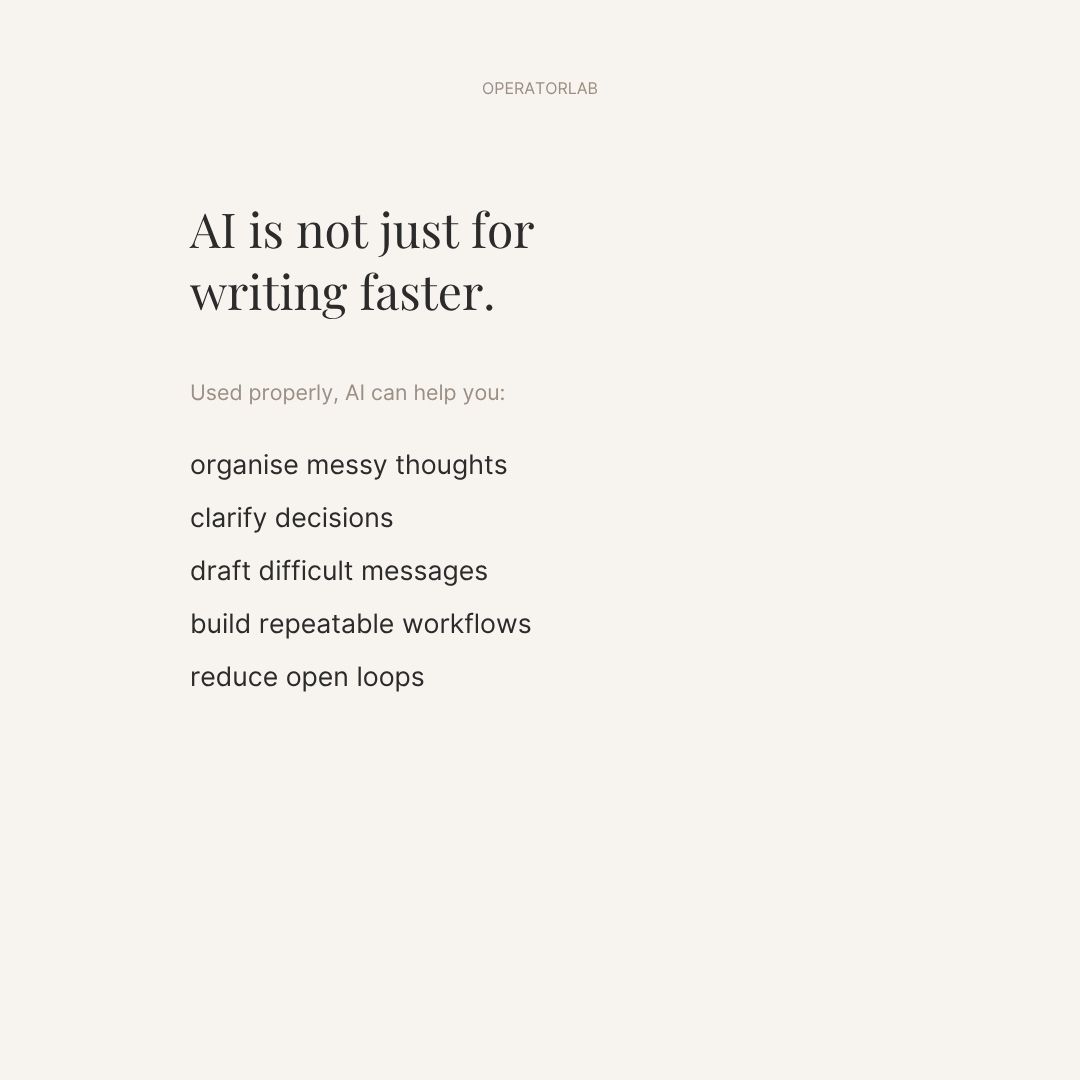
AI is not just for writing faster. Used properly, AI can help you organise messy thoughts, clarify decisions, draft difficult messages, build repeatable workflows and reduce open loops.
FROM VEN’S OPERATORLAB SERIES

Bring AI into the whole workflow.

Start with the thinking, decisions and follow-through around a task.

View full-size graphic
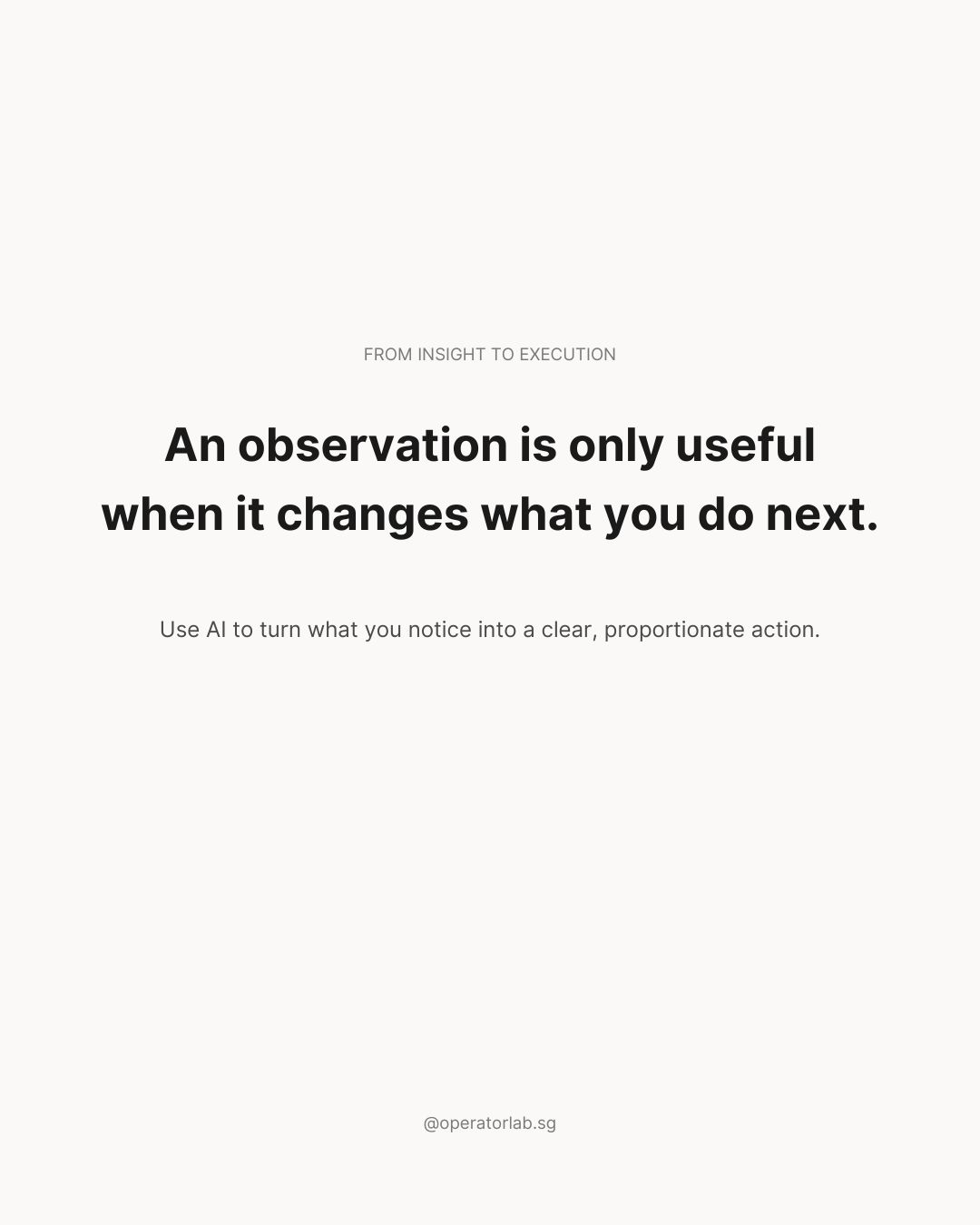
From insight to execution. An observation is only useful when it changes what you do next. Use AI to turn what you notice into a clear, proportionate action. @operatorlab.sg.
FROM VEN’S OPERATORLAB SERIES

Give each insight a next step.

Turn something you notice into an action you can take and review.

View full-size graphic
Compounded Knowledge Asset

Turn useful notes, decisions and lessons learnt into a knowledge library you can refine and reuse.

A practical starting pointCreate an approved answer bank for recurring customer questions and keep it current.

Executive Augmented Cognition

Use AI as a thinking partner to organise competing priorities and weigh options, while you make the decisions.

A practical starting pointTurn a busy week’s commitments into a focused operating plan with clear assumptions.

Master Reference & Source of Truth

Give your business’s current processes, voice and approved details a clear home.

A practical starting pointBuild a reference brief that keeps proposals, onboarding and AI-assisted drafts consistent.

RAGRetrieval-Augmented Generation

Understand how AI can retrieve relevant material from an approved knowledge base before drafting an answer.

A practical starting pointMap which procedures an internal assistant should use, who can access them and how answers should be checked.

Compounding Index & Context Leverage Ratio

Explore Ven’s working frameworks for assessing how a knowledge system develops and how useful context changes the effort a task takes.

A practical starting pointCompare briefing time, corrections and output quality on similar tasks before and after improving the source material.

Discuss these ideas with Ven

Before we begin.

What is workflow automation architecture?

It is the plan for how work moves through your business: what starts a task, which information is needed, which systems connect, who is responsible and when a person needs to review. That plan helps you decide what to automate and where AI is useful.

Is this for small businesses and solo founders?

Yes. We can begin with one recurring task, using the tools and time you already have. The focus is on founders, small business owners and growing teams, including mums building a business alongside family life.

Do I need to replace my existing tools?

We start by understanding what you use now. A clearer process or a better shared reference may be enough. Any new software or connection should have a practical reason and a cost you understand.

Can you guarantee time or cost savings?

We need a baseline first. We can compare time per completed task, review effort, errors and ongoing costs. Freed-up time creates capacity; it only becomes a cash saving if actual spending falls.

Does a consultation include a finished automation?

The starting offer is consultation, workflow design and practical AI guidance. We agree the deliverables and fee before booking. Any implementation, technical collaborator or ongoing support is scoped separately.

How do I enquire or arrange a consultation?

WhatsApp Ven on +65 8098 0781 or email founder@progresslab.sg with WWV Tech & AI enquiry, a little about your business and the task you would like to improve. We will clarify the focus, format and fee before confirming a session. Sending an enquiry does not book a session.

A clearer way to work starts with a conversation.

Enquire about a consultation

“There’s room for the mum you are and the dreams you hold—at your own pace.”